Siamese Algae Eater


Crossocheilus siamensis, 'courting behaviour'
~~~~~~~~~~~~~~~~~~~~~~~~~~~~~~~~~~~~~~~~~~~~~~~~~~~~~~~
White Cloud Mountain Minnows

breeding white clouds for pets or as feeder fish:
White cloud mountain minnows are vigorous, active, loosely schooling fish that display frequently and get along with most other aquarium inhabitants. They are simple to keep and easy to breed. They don't eat their eggs or babies and can be kept in multigenerational colonies. If you're going for volume (growing feeder fish, for example), remove the spawning media and/or fry to a seperate grow-out tank. Over-crowding in your breeding tank will reduce spawning.
Use at minimum a thirty three gallon aquarium with good filtration. White clouds breed best in room temperature aquariums (21C - 24C) with good water flow - they're river fish. Males display and court most vigorously in the outflow; when designing your layout, leave a wide clear area in front of the flow to give the males a long display run.
Spawning media: The aquarium should include a mass of floating plants, such as riccia, elodea, hornwort or naja grass for spawning; plastic plants and mops can also be for spawning. Hair algae and moss will also work. The spawning pairs with go into the plant mass to lay their eggs. Whichever plants you use, the mass should be dense. The use of floating plants will also encourage springtails, an excellent white cloud food.
Young fish gather in open water at the surface, near floating plants, making them easy to catch and transfer. Wait 'til they're about two weeks old and less fragile. If you don't chase them, white clouds often come to the net to check it out. Chase them and they will remember and run. Move slowly and use a soft, shallow net for this.
Substrate choice isn't critical. Rooted plants are nice but also not critical.
Feeding the babies: a mature tanks with plants, hardwood leaves and driftwood will host aufwuchs (biofilm and microorganisms), an ideal first food for the minuscule babies. You'll get better survival rates and stronger babies simply by going natural.
When you notice free swimming fry, supplement with small amounts of vinegar eels, finely powdered fry food, krill fines and microworms. I also feed frozen rotifers (when available), frozen baby brine shrimp and live young daphnia and copepods.
If you use a grow-out tank it should also be mature and feature plants, hardwood leaves and wood. Raising the temp in the grow out tank to 23C -24C will increase the growth rate.
Feeding the adults: Some breeders who raise white clouds to be feeder fish 'cheap out' on feeding. The garbage in/garbage out principle applies. Look after your breeding colony as carefully as your expensive trophy fish and you'll get better food fish. Feed a good staple flake food, supplemented with micro worms, live and frozen daphnia, live midge larvae, frozen blood worms/larvae, frozen brine shrimp etc.
Don't over crowd your breeding colony. It stresses the fish and will increase the pollutants in the water. If your feeders are infected with bacteria and other pathogens, your trophy fish will eventually get sick, too.
modified Novvember 1, 2013
this article may also be viewed at Canadian Aquarium Connection
~~~~~~~~~~~~~~~~~~~~~~~~~~~~~~~~~~~~~~~~~~~~~~~~~~~~~~~
Indian Dwarf Puffers (Pea Puffers)
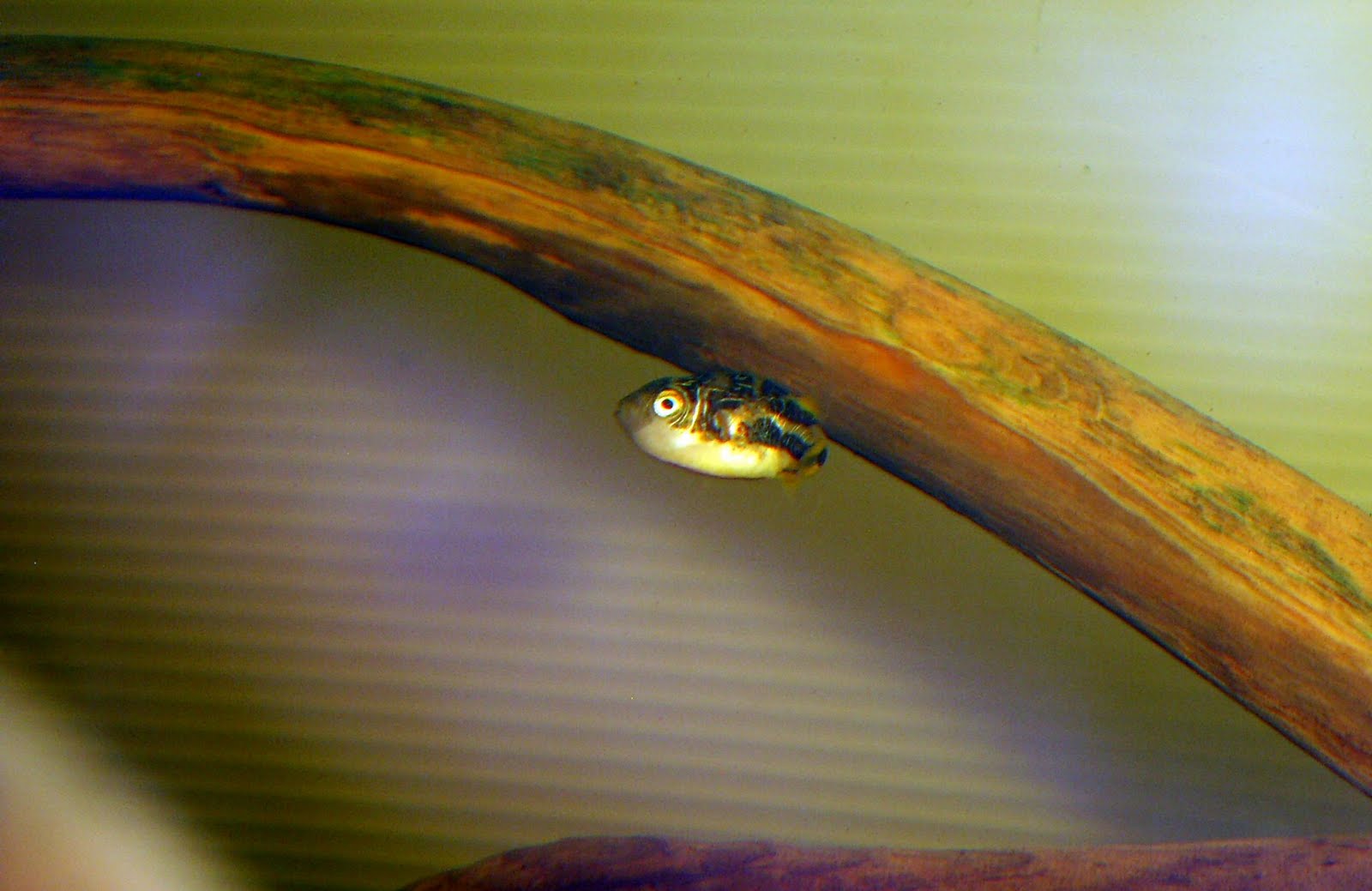
Breeding dwarf puffers
My puffers have been kind enough to breed for me on a few occaisions. This is how it worked for me:
20 gallon tank, temperture 26 - 28C; pH about 7.6, 2 teaspoons of salt to every 5 gallons of new water. The substrate is sand, covered in snail shells. (They have also spawned when the pH was only 7, so I don't think it's particularly critical as long as things are a little hard, and warm.)
Plants are critical. Boys play rough, and it's good to have a densely overgrown environment for females and fry to disappear into. Go for a 'Dutch-style' planting, even if you just use guppy grass and hornwort. Plants also foster the growth of rotifers, paramecia, copepods etc. - which babies enjoy munching on.
Spawning has always occurred in a raised clump of moss or hair algae. The male chases the female, then synchronizes his movements with hers, hanging beside her and a quarter body-length back. He butts her ventral region with his head, repeatedly. This goes on for a while until they slide into the moss, her first, then him, for a number of passes.
Diet (live): snails, copepods, daphnia, small scuds, new-born shrimp and fish larvae. Some will even take bites out of small fish. (frozen): foods such as bloodworm and brine shrimp. Puffers are lazy eaters. Feed them large snails and they'll just take a couple of bites and wander off. If the snails don't move, the puffs lose interest. That causes two problems: a lot of rotting snail carcass, and bad beaks. Feed really small snails, so that the whole thing gets eaten, shell included. This also helps to keep the beaks trimmed.
this article may also be viewed at Canadian Aquarium Connection
~~~~~~~~~~~~~~~~~~~~~~~~~~~~~~~~~~~~~~~~~~~~~~~~~~~~~~~
hatching corydoras eggs


^^in most community tanks the eggs will be eaten within hours; they must be relocated to hatch. The most straight forward method to collect the eggs is to lightly brush your (washed and thoroughly rinsed) hand against the eggs, rolling them gently so they stick to your fingers...

^^...then transfer the eggs into the hatching tank by brushing them lightly over some course plant material such as aquatic moss, elodea or, as shown in the photos, uprooted vallisneria. It's important to keep water moving over the eggs. An air stone set to a mild flow and positioned under the plant material is ideal for that purpose. It may take you several tries to get the hang of collecting the eggs, and you may break more than a few at first. Most of the common corys can easily be induced to spawn again with a water change, especially when the barometer drops.
 pictures of the babies in a few days...
hatching corydoras eggs

^^corydoras (cory) eggs on aquarium glass. These are from a single m/f pair of albino C. aeneus, kept with other corydoras species in an unheated soft water aquarium, ~20C at time of spawning.

^^in most community tanks the eggs will be eaten within hours; they must be relocated to hatch. The most straight forward method to collect the eggs is to lightly brush your (washed and thoroughly rinsed) hand against the eggs, rolling them gently so they stick to your fingers...

^^...then transfer the eggs into the hatching tank by brushing them lightly over some course plant material such as aquatic moss, elodea or, as shown in the photos, uprooted vallisneria. It's important to keep water moving over the eggs. An air stone set to a mild flow and positioned under the plant material is ideal for that purpose. It may take you several tries to get the hang of collecting the eggs, and you may break more than a few at first. Most of the common corys can easily be induced to spawn again with a water change, especially when the barometer drops.


Original images and text are free to copy, modify and use - just 1) credit me with a link pack to this blog and 2) pass on your modified work for free. Check out the license: this work by Storm is licensed under a Creative Commons Attribution-ShareAlike 3.0 Unported License.

